
Carroll County Scheduled vs Actual Release
A projected date is an estimate or system marker. An actual release date records when custody ended. Those are not interchangeable. For a sentenced Georgia prisoner, the record may display a release date, Tentative Parole Month, or Maximum Release Date. Each answers a different question. The Parole Board can reconsider a tentative decision before release, and a sentence calculation can change as new credits, court orders, or holds are posted.
A pretrial detainee at the Carroll County Jail usually has no computed sentence-expiration date because no final sentence exists. Release may instead follow bond, dismissal, a court order, transfer, or time served on a later sentence. The Interop roster shows arrest date and days in jail, but not the release timestamp or calculation. Do not turn those fields into an estimated exit date.
Find a Carroll County Projected Release
Choose the search by custody type. The Carroll County Jail / Jack T. Bell Detention Center holds local bookings and pretrial cases. Carroll County Correctional Institution can hold state inmates and State Court-sentenced people. Someone can therefore be physically housed in Carroll County while the controlling release record belongs to GDC and the Parole Board.
- Confirm the facility and sentence type. A live county-jail roster entry is not the same as a GDC state-inmate record.
- For a state inmate, open GDC Find an Offender, accept its disclaimer, and search by the most exact ID available.
- Compare the name, age, sex, race, case data, crime, and facility. A common name is not enough.
- Read each date label literally. Do not report a TPM as a final parole date or an MRD as proof of an early release.
- For parole timing, use the State Board’s TPM Lookup and remember that final review still must occur.
- For a local jail sentence, contact Sheriff open records at CCORT@carrollsheriffga.gov or 770-830-5916 and check the sentencing court.
- When a date has passed, confirm the actual custody outcome. The Carroll County release-record workflow shows how to distinguish release from transfer.
GDC advises users to verify online offender information through Inmate Records and Information, P.O. Box 1529, Forsyth, GA 31029. Its open-records portal is another route for state records. For a county sentence, ask for the booking and release record, release date and time, release reason, releasing authority, and whether another agency received the person.
Note: A person missing from the current Carroll County roster may have been released, transferred, or moved to another custody system.
Carroll County GDC Release Fields
The state search works best with an identifier. Georgia.gov says adults can be searched by name, ID or case number, age, and other identifying facts. GDC materials also point to crime, facility location, release-date information, and Tentative Parole Month. The fields help separate two people who share a name, but the online result remains a lead that should be verified.
| Search item | How it helps |
|---|---|
| GDC ID or inmate number | Targets one state offender more precisely than a name |
| Name and age | Narrows possible matches |
| Case number | Connects the state result with a court matter |
| Facility location | Shows the reported state placement, not a county-jail booking |
| Crime information | Helps confirm identity and flags sentence-specific limits |
| Release date | Shows the state system’s date entry, subject to verification |
| TPM | Marks a parole final-review month, not a guaranteed exit |
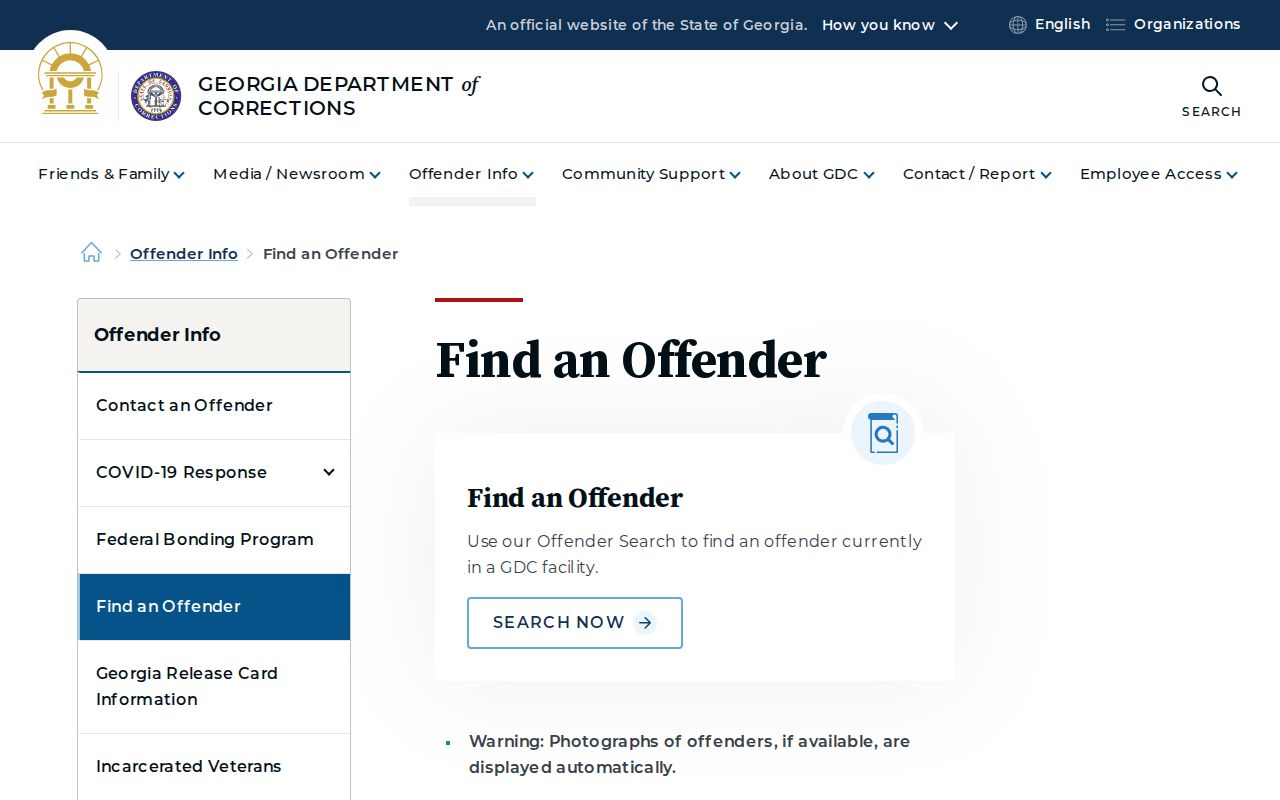
The official GDC offender-search page shows the state entry point used for Carroll County state inmates.
Carroll County State-Inmate Release Path
Carroll County Correctional Institution creates a local search trap. The county says the Horsley Mill Road facility houses more than 246 state inmates as well as people sentenced through State Court. It also states that the county receives about $22 per day for each state inmate. Those facts describe a county-operated institution with state-custody work, not an extension of the live Carroll County Jail roster.
For a state inmate there, use GDC, the TPM tool, and DCS or Parole Board records. For a State Court sentence or county work detail, the court and local facility record may control. A guarded work crew is still in custody. Seeing someone at a county work site is not evidence of release. The legal status and release authority matter more than the physical location.
Carroll County PIC Release Calculations
Georgia’s Performance Incentive Credit program, or PIC, can affect state-prison timing. It is not a simple county-jail good-time formula. GDC says eligible offenders earn points through standardized criteria tied to progress on a reentry plan. An eligible person can collect up to 12 points, potentially moving a TPM or MRD by one to twelve months.
O.C.G.A. 42-5-101 authorizes GDC work incentive credits for felony prison terms other than life imprisonment. Credits can reflect institutional achievement, work assignments, and satisfactory behavior. GDC reports them to the Parole Board for use in final parole-release decisions. The Board may reconsider PIC eligibility or a prior tentative decision when new information appears.
GDC excludes several groups from PIC, including probationers, death-sentence cases, short sentences of two years or less, non-parole-eligible or minimum-mandatory terms, and life sentences. Even an eligible person does not have a fixed mathematical promise. The point system, board review, behavior, program completion, and sentence law all interact.
Carroll County Parole Eligibility Limits
O.C.G.A. 42-9-45 supplies general parole-consideration timing. With exceptions, a felony inmate may be considered after nine months or one-third of the sentence, whichever is greater. Aggregate terms of 21 years or more generally reach consideration after seven years. This creates eligibility to be reviewed, not a right to leave prison.
O.C.G.A. 17-10-6.1 is the key warning for serious violent felony sentences. It defines covered offenses and can require a sentence to be served in full, with limits on parole, earned time, early release, work release, leave, and other reductions. Limited final-year transition provisions do not turn the statute into an across-the-board date rule. Mandatory minimums and other sentence terms can also control.
The parole process adds another layer. If the Board establishes a TPM, it completes final review in that month and may then set a parole release date. The Board says it can reconsider and change a prior decision up to release. The official Inmate TPM Lookup is useful for tracking review, but it is not the same as a scheduled gate date.
Why Carroll County Release Dates Change
A projected release date can move for reasons recorded by different offices. The table below identifies the source that should confirm each change. It avoids treating one portal as the full record.
| Factor | Possible effect | Best confirmation |
|---|---|---|
| PIC or work credits | May advance an eligible TPM or MRD | GDC and Parole Board |
| Misconduct or lost eligibility | May delay or remove an expected benefit | GDC and Board decision record |
| Parole final review | Can produce, postpone, or cancel a parole date | TPM lookup and Parole Board |
| Court order | Can alter sentence, bond, jail credit, or custody | Sentencing court docket |
| Detainer or agency hold | Can route the person to another agency | Custodian and receiving agency |
| Sentence recalculation | Can correct the state date | GDC Inmate Records |
| Local bond or dismissal | Can end county-jail custody without a prison calculation | Carroll County Sheriff and court |
A detainer is a request or legal hold from another authority. It may prevent a community release even when the local case would otherwise allow the person to leave. The Carroll County arrest-date view does not state the destination, release reason, or time. Ask whether the person was released to another agency when the outcome is unclear.
Confirm a Carroll County Release Date
Match the final check to the custodian. For a county-jail event, use Sheriff records and the court order. For a state-prison event, use the GDC record, written verification, and the Parole Board if parole is involved. Georgia VINE can send a custody-change notice, but an alert is not a full release sheet.
For Sheriff records, identify the person, arrest date, booking number if known, and the court shown in the roster. Ask for the exact release date and time, the release type or reason, the releasing authority, and whether the person went to another agency. Those details resolve gaps left by the arrest-date view, which can label a row “RELEASED” but does not publish the timestamp, reason, or destination. The court docket then shows whether bond, dismissal, sentence completion, probation, or another order changed the case.
For GDC records, save the offender identifier and the label attached to each date. If the online entry conflicts with a court order or a prior result, request verification through GDC Inmate Records or the GDC open-records portal. GDC states that its initial response is due within three business days and that copy, search, and redaction costs may apply. A written reply creates a clearer record than an estimate based on sentence length.
After release, compare the actual date with the prior projection. If the person is on parole or felony probation, DCS may hold the next community-supervision record. If the record instead says transfer, follow the receiving agency. This last step prevents a projected Carroll County release date from being mistaken for proof that the person returned to the community.