
Carroll County Release Records
A release ends one period of custody, but it does not always mean a return to the community. For Carroll County released inmates, the online jail record may change from “CURRENTLY BOOKED” to “RELEASED.” A person may also leave the local roster because another agency took custody. The Carroll County Sheriff's Office holds the county booking and release record. The court holds the case outcome. The Georgia Department of Corrections, or GDC, holds the state-prison record. Federal and immigration agencies use separate systems.
The word “release” therefore needs context. Bond can end jail custody while a case stays open. Time served means the confinement term or custody credit has been met. A transfer ends the county's physical custody but does not free the person. Parole ends prison confinement under community supervision, while probation is a court-ordered term that may follow or replace confinement. A discharge marks the end of a sentence or supervision term. These distinctions decide which Carroll County release record can give the next clear answer.
- Time served
- Credit or a completed term that satisfies the ordered jail time.
- Transfer
- Movement from one custodial agency or facility to another, not community release.
- Parole
- Conditional release from state prison before the full sentence ends.
- Probation
- Court-ordered supervision in the community, sometimes after a split sentence.
- Discharge
- Formal completion of a sentence or supervision obligation.
Carroll County Release Routes
The right source depends on how custody ended. Interop, the sheriff-linked jail system, does not display the release reason. Its arrest-date view can confirm that a local booking now has “RELEASED” status, but a bond amount does not prove bond was posted. Days in jail do not supply the exact exit time. The formal record or court file is needed to tell one route from another.
| Release route | What it means | Best next record |
|---|---|---|
| Bond | Local custody ends while the case may remain pending. | County release record and bond order |
| Time served | Jail time or credited custody meets the confinement term. | Sentencing order and release record |
| Dismissal or no further hold | The cited case no longer supports detention. | State, Superior, or Municipal Court disposition |
| GDC transfer | County custody ends and state custody begins. | GDC offender search and state records |
| Parole or probation | Confinement ends with community supervision. | Parolee search, court order, and DCS |
| Federal or immigration transfer | Another sovereign agency takes custody. | BOP, ICE, federal court, or transfer record |
A Carroll County released inmate may have more than one record. A local booking row may connect to a court order and then to a state or federal custody result. Match the name, arrest date, court, warrant number, and charge context before treating two records as the same case.
Note: A posted bond amount can help route a search, but it does not prove the bond caused release.
Inside Carroll County Release Records
The public Interop row is a roster record, not a full release sheet. It can show that the listed booking is no longer active, yet it omits the release date, time, reason, approving authority, destination, property status, and final court result. Those missing fields are the reason to seek the Sheriff's Office release record when exact proof matters.
| Field | What it shows |
|---|---|
| Name and identity details | Helps match the person to the correct booking. |
| Booking or arrest date | Links the release request to the custody episode. It is not the release date. |
| Release date and time | States when county custody ended. This is absent online. |
| Release type or reason | Distinguishes bond, time served, court order, transfer, or another route. |
| Releasing authority | Identifies the court or official basis for the release where releasable. |
| Receiving agency | Shows whether the person went to GDC, another county, USMS, ICE, or another custodian. |
| Court and charge fields | Route the next search to the court that holds the case disposition. |
The roster's status, bond, days-in-jail, warrant, statute, description, and court fields still help. They give records staff enough context to locate the booking. They also help a reader avoid a false match. None should be read as proof of guilt or a final court outcome.
Request Carroll County Release Records
The Carroll County Sheriff's Office directs all sheriff open-records requests to CCORT@carrollsheriffga.gov or 770-830-5916. Ask for the booking and release record, not a broad file. A focused request is faster to identify and makes clear which missing facts are needed.
- Give the full name and date of birth, if known. Add the arrest date, booking number, charge, and court when available.
- Ask for the release date and time, release reason or type, releasing authority, and the receiving agency if the person was transferred.
- Attach or describe the Interop arrest-date row when it already shows “RELEASED.” This ties the request to the exact booking.
- Request a written cost estimate if a search or large copy set may create fees.
- Use the court docket or state system after the response identifies a court, GDC, or another receiving agency.
Georgia's Open Records Act permits inspection and copying unless a record is exempt. Under O.C.G.A. 50-18-71, available records generally must be produced within three business days. If they are not then available, the agency must describe them and provide a timeline. Search, retrieval, redaction, and copy costs may apply. Letter or legal copies are generally capped at ten cents per page unless another fee law controls.
The broader Carroll County open-records channel handles county-government records through the County Clerk. It provides the first 15 minutes of staff time and 20 pages at no cost, then lists copies at ten cents per page. Jail and sheriff release requests should still go to the Sheriff's Office channel because that office gives a direct instruction for its records.
Carroll County Record Access Limits
Online visibility can change after a case ends. Georgia record restriction is governed by O.C.G.A. 35-3-37. GBI says arrests after July 1, 2013, generally start with the prosecutor, while older arrests use an application through the arresting agency. First-offender discharge is addressed by O.C.G.A. 42-8-60, and O.C.G.A. 42-8-62.1 can limit public access to covered court and law-enforcement records.
Restriction does not guarantee that every administrative release record vanishes. A court order, the type of record, and the agency's legal duties control access. Check the court, prosecutor, arresting agency, GBI, and Sheriff's Office for the exact record. The GBI restriction guidance explains the state process, while the originating office can address the local file.
The manifest capture from the county request page shows the county's stated access route and fee framework.
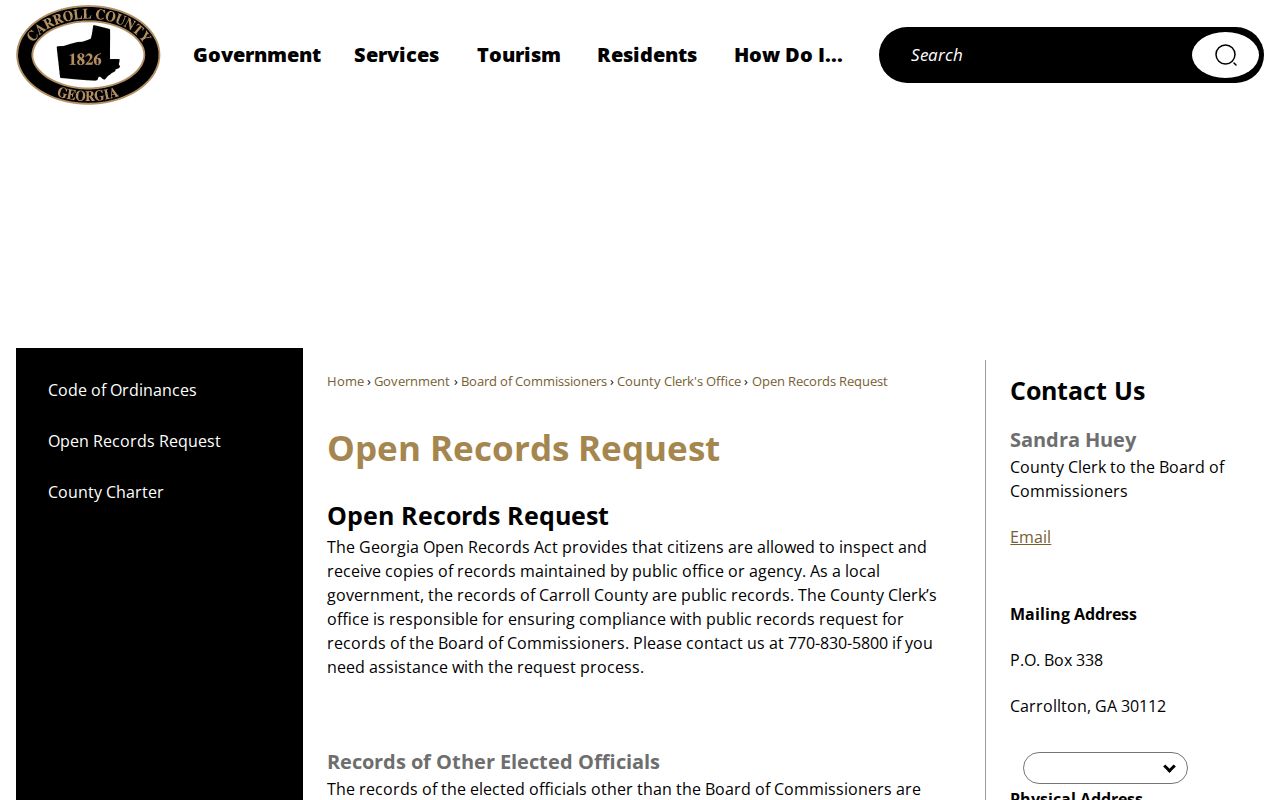
That county page supports general requests; the sheriff's published email remains the direct path for jail release records.
Note: A restricted court or history record may change public access without erasing every agency's administrative custody record.
Carroll County Jail Name History
Older Carroll County release records may use a different facility name. The Sheriff's Office moved from downtown Carrollton to 1000 Newnan Road in 1979. That jail was designed for 85 people. In October 2001, operations shifted into the Jack T. Bell Detention Center, designed for 644 people. The old building became a 124-bed women’s custody unit, and 48 maximum-security beds were added in 2006.
Those changes explain why “Carroll County Jail” and “Jack T. Bell Detention Center” can refer to the same main local custody path. A records request should use both names when the booking date or source is old or unclear. The Sheriff's jail history and county jail page document the sequence.
Carroll County Release Funds
Property and funds may follow a different process from the release record. The Carroll County jail FAQ says commissary credit is not extended, inmate-to-inmate fund transfers are not allowed, and checks from an inmate's account are issued only to that inmate except in emergencies. It does not publish a release-hour property window, so no fixed pickup time should be assumed.
For a state-prison release, GDC has a separate Georgia Release Card process for money left on the books. That state process does not prove how the county jail returns funds. Questions about a local account or property should go to the jail at 770-830-5888, while the release record itself remains an open-records issue.
Find Carroll County Released Inmates
Start with the custody type, not just the name. County jail, state prison, federal prison, and immigration custody have separate public paths. For the county jail, the most useful online view is “Inmates by Arrest Date.” It accepts a date range and can display “RELEASED” or “CURRENTLY BOOKED” beside a matching row.
- Open the Carroll County arrest-date view. Search around the known arrest or booking date and match the person carefully.
- Read the status. “RELEASED” means that booking is no longer active in the online county roster. “CURRENTLY BOOKED” means the person remains listed in local custody.
- Copy the arrest date, arresting agency, court, warrant, and charge fields. Use the court field to search the right case record.
- If state custody is possible, search GDC by an exact ID or by name and other identifiers.
- Use Georgia VINE for custody-change notices, the parole tools for state supervision, or BOP and ICE for their own custody systems.
- When the online result is absent or vague, request the release record and ask whether another agency received the person.
Carroll County does not publish a true 24-hour or 72-hour release feed. The resolved Jail Releases: 24 Hours page explains the same-day fallback, while a named-person search should still follow the custody route above.
Carroll County State Release Search
The GDC Find an Offender tool applies when a person entered Georgia state custody. That includes state inmates held at Carroll County Correctional Institution. It does not replace the sheriff roster for someone held only at the county jail. Search with the most exact identifier available, then compare the location, crimes, case context, and identity details.
| Search field | Use | Limit |
|---|---|---|
| GDC ID or inmate number | Best exact match for a state offender | Not a county booking number |
| Name | Broad search when no ID is known | Common names require more matching |
| ID or case number | Links the search to state records | Format must match the state system |
| Age and other identifiers | Narrows same-name results | Fields vary by result |
| Location, crime, release date or status | Shows the state-custody context | GDC warns online data may be incomplete |
GDC directs users to written verification through Inmate Records and Information, P.O. Box 1529, Forsyth, GA 31029. Its open-records portal also accepts state records requests. A Tentative Parole Month is not a final release date. It marks the month for final board review, and the board may change a prior decision before release.
Note: GDC state identifiers and a Carroll County jail booking number belong to different record systems and are not interchangeable.
Carroll County Recent Release Search
The sheriff-linked system has a “24 Hours Arrests” page, not a release list. It covers recent bookings and was empty when the research view was accessed. No official Carroll County, Georgia, 72-hour release feed was found. Do not use a similarly named Carroll County system from another state.
The arrest-date view is the better local release clue because its rows can show “RELEASED.” Yet it is keyed to arrest date, not release date. Someone booked weeks before release may be missed if the search window covers only the last day. No official update cadence or retention term is stated. Check the live view, then call the jail or request the formal record when timing matters.
The Sheriff's Office home page publishes the open-records route used for that fallback.

This capture helps locate the county contact, while the requested release sheet supplies the date, reason, and transfer details missing from Interop.
Note: The arrest-date view can retain released rows beyond one day, but Carroll County states no guaranteed online retention period.
Carroll County Release Court Lookup
Interop gives a useful local shortcut: each charge row includes a court field. Copy it before opening the Carroll County party search. Superior Court records may show felony charges, pleas, sentences, revocations, and orders. State Court handles misdemeanor criminal cases accused by the county solicitor and traffic-related matters. Municipal Court can hold city cases, while Magistrate Court may hold warrant, first-appearance, or bond records.
The court file can explain what “RELEASED” does not. It may show a bond order, sentence credit, probation, dismissal, revocation, discharge, or a case that is still pending. A court label on a roster row is only a routing clue. It does not, by itself, establish the charge result.
Carroll County State Inmate Releases
Carroll County Correctional Institution creates an unusual local split. The county says the Horsley Mill Road facility houses more than 246 state inmates plus people sentenced through State Court. It also reports GDC compensation of about $22 per day for each state inmate. A person can be physically held in Carroll County while the correct release record is state-level.
For a state inmate there, use GDC, the Parole Board's TPM lookup, the parolee database, and DCS supervision. For a State Court sentence served locally, use the court record and local facility channel. Guarded work crews at county sites remain in custody. A public sighting on a crew does not show release.
Carroll County Release Supervision
The Georgia State Board of Pardons and Paroles makes parole decisions. The Department of Community Supervision, or DCS, supervises felony parole and probation in the community. DCS assigns many cases by the person's place of residence instead of by the parole or probation label alone.
The DCS Carrollton virtual office serves Carroll, Heard, and the West Georgia Circuit. It lists P.O. Box 326, Carrollton, GA 30112, weekday hours from 8:00 a.m. to 4:30 p.m., and phone 470-728-4540. Use the Parolee Search for a released parolee. For probation, begin with the sentencing court, then use DCS for felony supervision confirmation.
Note: No official Carroll County release-focused parole or probation absconder list was confirmed in the reviewed sources.
Carroll County Release Or Transfer
The Sheriff's jail population page discusses Georgia HB1105 duties related to non-citizen inmate intake and reporting. That county note does not prove that any named person has an ICE hold. It does show why “gone from the roster” must not be equated with release to the community.
Ask the Sheriff's Office whether the person was released to another agency and request the receiving agency when releasable. If immigration custody is indicated, use the official ICE detainee locator. If USMS or federal custody appears, use federal court records and the BOP locator. A past date with no facility in a BOP result means the person left BOP custody on that date, though another form of custody or supervision may still apply.
Note: Carroll County's HB1105 reporting statement is not proof that ICE placed a hold on any particular person.
Carroll County Release Notifications
Georgia VINE provides custody-status and criminal-case information for participating feeds. Search one person by name or ID, compare matches, open the custody record, and register for an available phone, email, or app alert. The Georgia VINE number is 1-833-216-6670. Phone registration uses a four-digit PIN to confirm receipt.
VINE is a notice channel, not a full Carroll County release record. A missing person does not prove release, and a status change may not state the exact time, reason, destination, property return, or court result. Pair VINE with Interop, the records request, GDC, or the court based on who held custody.
Carroll County Custody Status Sources
Each public system answers a different question. A current roster is a snapshot. A release record proves how a local custody episode ended. State and federal tools apply only when those systems held the person.
| Source | Best use | What it cannot prove alone |
|---|---|---|
| Interop Current Inmates | Who is still listed in Carroll County jail custody | Why a missing person left the list |
| Interop Inmates by Arrest Date | “RELEASED” versus “CURRENTLY BOOKED” for a known booking | Release date, reason, or destination |
| Sheriff release record | Exact local custody end and transfer details | Final court result unless included |
| GDC offender search | State custody, location, crime, date, or status information | A county-only jail release |
| Court docket | Bond, disposition, sentence, probation, revocation, discharge | Live physical custody at every moment |
| BOP or ICE locator | Federal or immigration custody routing | Carroll County's local release reason |
When sources conflict, use the most specific originating office. Ask that office to confirm the record in writing. A name-only match should never outweigh a booking number, agency ID, date, and court context.
Carroll County Release Facilities
Two local facilities use different release paths. The main jail holds local bookings and uses the Sheriff's release record. The correctional institution holds state inmates and State Court-sentenced inmates, so GDC and court records may control.
- Carroll County Jail / Jack T. Bell Detention Center: use Interop's arrest-date view, then the Sheriff's Office record for the exact release or receiving agency.
- Carroll County Correctional Institution: use GDC and parole tools for a state inmate, or State Court and local records for a county sentence.
Municipal police can be the arresting agency, but the Sheriff's Office holds the jail custody record after county booking. The arresting police agency keeps its incident or arrest report, while the court keeps the case outcome.
Public Record Search
Sponsored Results